
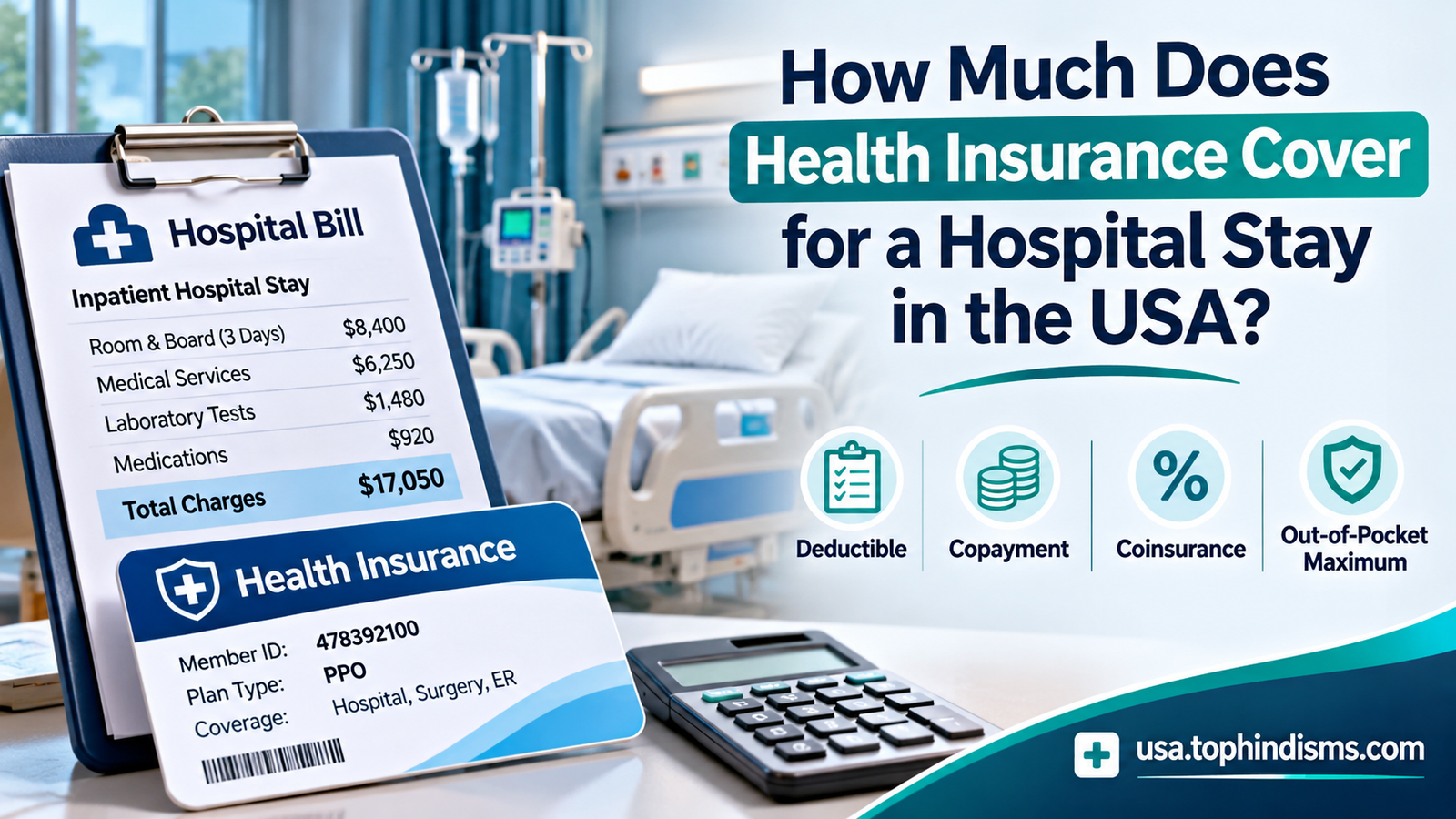
A hospital stay can lead to one of the largest medical bills a person ever receives. Even with health insurance, figuring out how much you’ll actually have to pay isn’t always straightforward.
Let’s say you’re admitted to a hospital for three days. You receive treatment, undergo a few tests, and eventually return home. A few weeks later, you see a hospital statement showing thousands of dollars in charges.
Your first thought might be: I have health insurance. Doesn’t that cover most of this?
The answer depends on your health plan, the hospital’s network status, the services you received, and how much of your deductible and out-of-pocket maximum you’ve already paid.
Health insurance can cover a substantial portion of an eligible hospital stay, but there is no universal percentage that every insurance plan pays.
Here’s how hospital coverage works in the United States, what you may still owe, and how to estimate your costs before receiving treatment.
Does Health Insurance Cover Hospital Stays?
Most comprehensive health insurance plans in the United States include coverage for medically necessary hospital services, subject to the terms of the policy.
For example, health insurance plans sold through the federal or state Health Insurance Marketplaces must cover essential health benefits, including hospitalization.
Hospitalization benefits generally include services such as surgery and overnight hospital stays.
However, having coverage doesn’t mean every hospital expense will be paid in full.
Your insurance plan may require you to pay a deductible, copayment, or coinsurance. Coverage may also depend on whether the hospital is in your plan’s provider network.
Some services require prior authorization, while others may be excluded or subject to specific medical necessity requirements.
The best place to start is your plan’s Summary of Benefits and Coverage (SBC), which explains important cost-sharing and coverage terms.
How Much Will Insurance Actually Pay?
There is no single dollar amount or percentage that applies to every hospital stay.
Consider these three situations:
- A patient with a low deductible and a relatively small hospital copayment may owe much less than the hospital’s original charges.
- Someone with a high-deductible health plan may have to pay a substantial amount before insurance begins paying according to the plan’s cost-sharing terms.
- A patient who has already reached the plan’s in-network out-of-pocket maximum may owe nothing further for additional covered in-network essential health benefits during the same plan year.
These situations can lead to very different bills, even when patients receive similar treatment.
To understand why, we need to look at how hospital claims are calculated.
How Hospital Insurance Billing Works
When a hospital bills your insurance company, the amount it charges may be very different from the amount your insurance plan recognizes.
There are several important figures to understand.
| Billing Term | What It Means |
|---|---|
| Hospital billed charges | The amount the hospital initially bills |
| Allowed amount | The amount recognized under the insurance plan’s payment terms |
| Contractual adjustment | The difference removed under an applicable provider-insurer agreement |
| Deductible | The amount you must pay for covered services subject to the deductible |
| Copayment | A fixed amount charged under your plan for certain services |
| Coinsurance | A percentage of the allowed amount you pay |
| Insurance payment | The amount paid by your health plan |
| Patient responsibility | The amount you may owe after the claim is processed |
An insurance adjustment isn’t necessarily money paid by the insurance company. It may be a reduction required under the provider’s contract.
That distinction can make a hospital bill much easier to understand.
Example: How a $30,000 Hospital Bill Could Be Divided
Suppose you receive a $30,000 hospital bill after an inpatient stay.
For this hypothetical example, assume:
- The hospital is in your insurance network.
- The care is covered.
- The insurance company’s allowed amount is $12,000.
- You have $2,000 remaining on your deductible.
- Your plan requires 20% coinsurance after the deductible.
- You haven’t reached your out-of-pocket maximum.
- No separate copayment or additional uncovered charges apply.
Here’s how the simplified calculation could work.
| Description | Amount |
|---|---|
| Original hospital charges | $30,000 |
| Contractual adjustment | −$18,000 |
| Insurance allowed amount | $12,000 |
| Remaining deductible paid by patient | $2,000 |
| Remaining amount after deductible | $10,000 |
| Patient’s 20% coinsurance | $2,000 |
| Total patient responsibility | $4,000 |
| Insurance payment | $8,000 |
In this example, the hospital originally billed $30,000, but the patient would owe $4,000 under the assumed coverage terms.
This is an illustration, not a real hospital claim or a typical national price.
Actual claims may involve multiple providers, different deductibles, copayments, separate professional charges, or other rules. The plan’s out-of-pocket limit could also reduce the amount the patient owes.
What Does a Hospital Deductible Mean?
A deductible is the amount you pay for covered services subject to that deductible before your insurance begins sharing certain costs.
Let’s say your annual deductible is $3,000.
If you’ve already paid $2,200 toward it, you generally have $800 remaining.
When your next covered hospital claim is processed, that remaining deductible may become part of your responsibility.
However, not every service is subject to the same deductible rules.
Some plans have separate deductibles, fixed copayments, or different arrangements for particular services.
It’s also important to remember that a deductible is not necessarily the maximum you will pay.
After satisfying the deductible, coinsurance or copayments may still apply until you reach your plan’s applicable out-of-pocket maximum.
Hospital Copayment vs. Coinsurance
Hospital coverage often involves one or both of these cost-sharing arrangements.
Hospital Copayment
A copayment is a fixed amount charged for a covered service under your plan.
For example, a hypothetical plan might charge a fixed copayment when you are admitted to a hospital.
Some plans apply a per-admission copayment, while others may use different rules.
Always check your own policy rather than assuming every hospital admission has the same charge.
Hospital Coinsurance
Coinsurance is usually calculated as a percentage of the allowed amount for a covered service.
For instance, a plan with 20% coinsurance may require you to pay that percentage after the applicable deductible is satisfied.
Your actual responsibility can also be affected by your out-of-pocket maximum.
A plan that says it pays 80% of covered hospital costs does not necessarily mean the insurance company pays 80% of the hospital’s original billed charges.
The percentage generally applies to amounts determined under the plan’s coverage and payment rules.
What Is the Out-of-Pocket Maximum?
Your out-of-pocket maximum is one of the most important numbers to understand when planning for expensive medical care.
For covered in-network services, this limit generally caps the amount you must pay through applicable deductibles, copayments, and coinsurance during a plan year.
Once you meet that limit, a qualifying plan generally pays 100% of covered in-network essential health benefits for the remainder of the plan year.
2026 Marketplace Out-of-Pocket Limits
For the 2026 plan year, federal Marketplace rules set these maximum permitted amounts:
| Coverage Type | 2026 Maximum |
|---|---|
| Individual coverage | $10,600 |
| Family coverage | $21,200 |
These are upper limits for applicable Marketplace coverage, not amounts every plan requires you to pay.
Your own plan may have a lower maximum.
Also, the limit generally does not include monthly premiums, noncovered services, or ordinary out-of-network expenses. Certain other charges may also fall outside the limit.
If you’re comparing insurance plans, look beyond the monthly premium and consider the deductible, coinsurance, and out-of-pocket maximum together.
In-Network vs. Out-of-Network Hospital Costs
A hospital’s network status can make a major difference in how your insurance claim is processed.
In-Network Hospitals
An in-network hospital has a contract with your health insurance plan.
For covered services, the agreement generally establishes the applicable negotiated payment terms.
Using an in-network hospital may reduce the risk of unexpected charges and help ensure that eligible cost-sharing amounts count toward your in-network out-of-pocket limit.
Out-of-Network Hospitals
An out-of-network hospital does not have the same contractual relationship with your plan.
Depending on your policy, nonemergency out-of-network care might involve higher cost-sharing, a separate deductible, limited coverage, or no coverage.
However, federal and state billing protections may apply in certain situations.
For example, the federal No Surprises Act provides protections against many unexpected out-of-network bills for emergency services and certain nonemergency services at in-network facilities.
It does not mean every out-of-network hospital visit will receive in-network coverage.
Before scheduled treatment, confirm the hospital’s network status directly with your insurer.
Does Insurance Cover Emergency Hospital Admissions?
Many comprehensive health plans cover emergency hospital services, but the specific circumstances still matter.
Federal protections generally prohibit certain surprise out-of-network emergency bills for people covered by qualifying private health plans.
These protections may also restrict the cost-sharing that can be imposed for covered emergency services.
However, the protections have eligibility requirements and exceptions.
For example, not every type of limited-benefit insurance policy receives the same protections.
Emergency transport may also generate separate charges, and federal surprise-billing protections generally do not cover ground ambulance services.
If you receive an unexpected emergency bill, check your Explanation of Benefits and ask your insurer how the claim was processed.
Does Insurance Pay for Surgery During a Hospital Stay?
Insurance may cover medically necessary surgery when the procedure and related services meet the plan’s requirements.
Potentially covered expenses can include:
- Hospital facility services
- Operating room services
- Surgeon and other physician services
- Anesthesia
- Certain laboratory tests
- Medical imaging
- Medications administered during care
- Postoperative hospital services
Not every charge is necessarily included in a single payment.
Some physicians or professional groups bill separately.
Coverage can also depend on medical necessity, network participation, prior authorization, and other plan terms.
If you are scheduling surgery, ask your insurer for a procedure-specific coverage explanation.
What About Prior Authorization?
Some insurance plans require prior authorization before particular nonemergency hospital services or procedures.
Prior authorization means the insurer reviews information and makes a coverage determination before the service is provided.
However, authorization is not an unconditional guarantee that every charge will be paid.
Claims can still depend on eligibility, the services actually performed, and applicable plan requirements.
Before planned treatment, ask:
- Does this service require prior authorization?
- Has the necessary authorization been obtained?
- Are the hospital and physicians in-network?
- Which services are included in the estimate?
- What portion of the cost may become my responsibility?
Keep copies of authorization notices and other relevant documents.
Does Staying Overnight Mean You’re an Inpatient?
Not always.
A patient may spend a night in the hospital while receiving outpatient observation services rather than being formally admitted as an inpatient.
This distinction is especially important for Medicare beneficiaries.
For Original Medicare, an inpatient hospital admission generally requires an appropriate inpatient order.
Observation services are usually treated as outpatient services.
The classification can affect which Medicare benefits apply and how certain costs are calculated.
If your hospital stay involves observation care, ask the hospital to explain your patient status and how your insurance will process the services.
How Much Does Medicare Pay for a Hospital Stay?
Original Medicare uses different rules from many private insurance plans.
Medicare Part A generally helps cover qualifying inpatient hospital care, while Part B covers many physician and outpatient services.
For 2026, the Medicare Part A inpatient hospital deductible is $1,736 per benefit period.
For covered inpatient hospital stays under Original Medicare, after the Part A deductible, the daily hospital coinsurance for days 1–60 is generally $0.
Different daily coinsurance amounts apply to longer stays.
Physician services billed under Part B may involve separate cost-sharing.
Medicare Advantage plans have their own approved benefit and cost-sharing structures.
Medicare supplemental insurance may also affect a beneficiary’s responsibility.
For a personal estimate, review the applicable Medicare coverage arrangement rather than treating Part A rules as a complete hospital cost calculation.
How to Estimate Your Hospital Costs Before Admission
If your treatment is scheduled rather than an emergency, you may have time to compare financial information.
Start by gathering three documents:
- Your insurance plan’s Summary of Benefits and Coverage.
- A written estimate from the hospital.
- A coverage or cost estimate from your insurance company.
Ask the Hospital for an Estimate
Request a written estimate for the expected services.
Find out whether it includes the hospital facility charge, physician services, anesthesia, imaging, laboratory work, medications, and possible additional fees.
Some expenses may not be predictable before treatment.
Ask the hospital to identify what is included and excluded.
Check Hospital Price Transparency Information
U.S. hospitals are subject to federal price transparency requirements.
These rules generally require hospitals to publish certain standard charge information, including discounted cash prices and payer-specific negotiated charges, as well as consumer-friendly information about shoppable services.
However, a published negotiated rate is not automatically your personal out-of-pocket cost.
Your deductible, coinsurance, plan limits, and the services you receive still matter.
Contact Your Insurance Company
Ask the insurer to confirm the hospital’s network status and provide an estimate of your responsibility for the expected care.
Also ask whether the physician groups involved are in-network and whether prior authorization is needed.
A written estimate can help you prepare, but it may not be a final payment determination.
What If Your Insurance Company Denies a Hospital Claim?
A denied insurance claim doesn’t always mean you have no options.
Start by reading the denial notice and Explanation of Benefits.
Identify whether the denial involves medical necessity, prior authorization, coverage exclusions, network status, coding, or missing information.
You can then contact the insurer or hospital billing department for clarification.
For many qualifying health plans, consumers have rights to internal appeals and, in some circumstances, independent external review.
HealthCare.gov explains that an internal appeal generally must be filed within 180 days of receiving a claim denial notice for plans subject to those requirements.
Specific deadlines and review procedures may differ depending on the type of plan.
Keep copies of communications, denial notices, medical billing records, and appeal documents.
How to Compare Health Insurance Plans for Hospital Coverage
If hospital expenses are an important concern, the cheapest monthly premium is not always the least expensive plan overall.
Consider the following factors.
| Plan Feature | What to Compare |
|---|---|
| Monthly premium | What you pay to maintain coverage |
| Deductible | How much you may pay before certain benefits begin sharing costs |
| Inpatient hospital coverage | Copayments, coinsurance, and coverage restrictions |
| Out-of-pocket maximum | Your potential limit for qualifying covered services |
| Provider network | Whether preferred hospitals and physicians participate |
| Prior authorization | Requirements for planned procedures |
| Prescription coverage | Applicable medication costs and restrictions |
| Rehabilitation coverage | Physical therapy or other post-hospital benefits |
For example, someone expecting a planned procedure may find that a plan with a higher premium but a lower deductible and out-of-pocket maximum better fits their expected healthcare needs.
Someone with different circumstances may reach another conclusion.
The correct comparison depends on total expected costs, covered services, provider access, and the terms of each plan.
What Should You Check After Receiving a Hospital Bill?
When your hospital statement arrives, don’t look only at the final amount.
Compare it with the Explanation of Benefits from your insurance company.
Pay attention to:
- Whether the claim has finished processing
- The hospital’s billed charges
- Any contractual adjustments
- The insurance plan’s allowed amount
- Deductible and coinsurance calculations
- The insurance payment
- Your stated responsibility
- Separate bills from other providers
An Explanation of Benefits is not itself a bill.
If the hospital is requesting an amount that doesn’t match the insurer’s final determination, ask both organizations to explain the difference before assuming the amount is correct.
Frequently Asked Questions
Does health insurance pay 100% of a hospital bill?
Not always. Many plans require deductibles, copayments, or coinsurance. However, qualifying covered in-network services may be paid in full by the plan after the applicable out-of-pocket maximum has been reached.
How much does a three-day hospital stay cost with insurance?
There is no universal amount. Your responsibility depends on the hospital’s allowed charges, the care received, your plan’s cost-sharing requirements, and how much you’ve already paid toward your deductible and out-of-pocket maximum.
Will insurance cover an overnight hospital stay?
Comprehensive plans generally cover eligible inpatient hospital services, subject to policy requirements. However, an overnight stay does not automatically mean you were formally admitted as an inpatient.
Can I still owe thousands of dollars with health insurance?
Yes. A high deductible, coinsurance, separate professional charges, or noncovered services may lead to substantial out-of-pocket expenses.
Does a hospital’s published price equal what insurance will pay?
No. Published prices may represent gross charges, cash prices, or negotiated rates. Your insurer’s allowed amount and your own cost-sharing responsibility may differ.
Does Medicare cover hospital stays?
Original Medicare Part A generally covers qualifying inpatient hospital care, subject to deductibles, coinsurance, and program rules. Part B may cover associated physician services and outpatient care.
What should I do if I think my hospital insurance bill is wrong?
Compare the bill with the final Explanation of Benefits, request clarification or an itemized statement, and contact the insurer and billing department. If a claim has been denied, review available appeal rights.
Final Thoughts
Health insurance can protect you from some of the financial risks of a hospital stay, but coverage doesn’t eliminate every expense.
Understanding the difference between billed charges, allowed amounts, deductibles, coinsurance, and out-of-pocket maximums can help you make sense of what you actually owe.
Before planned care, ask your insurer and hospital for written estimates and confirm network participation and coverage requirements.
After treatment, review your Explanation of Benefits before paying a bill you don’t understand.
The most important question isn’t simply how much insurance pays. It’s how your particular plan calculates your responsibility for the care you receive.
Sources and Further Reading
- HealthCare.gov — What Marketplace Health Insurance Plans Cover
- HealthCare.gov — Summary of Benefits and Coverage
- HealthCare.gov — Out-of-Pocket Maximum
- HealthCare.gov — Your Total Costs for Health Care
- CMS — Hospital Price Transparency for Consumers
- CMS — Know Your Medical Bill Rights When Using Insurance
- Medicare.gov — Inpatient Hospital Care Coverage
- HealthCare.gov — Internal Appeals
Disclaimer: This article provides general educational information and does not replace individualized insurance, medical, financial, or legal advice. Coverage and billing requirements depend on individual circumstances and applicable plan terms.