
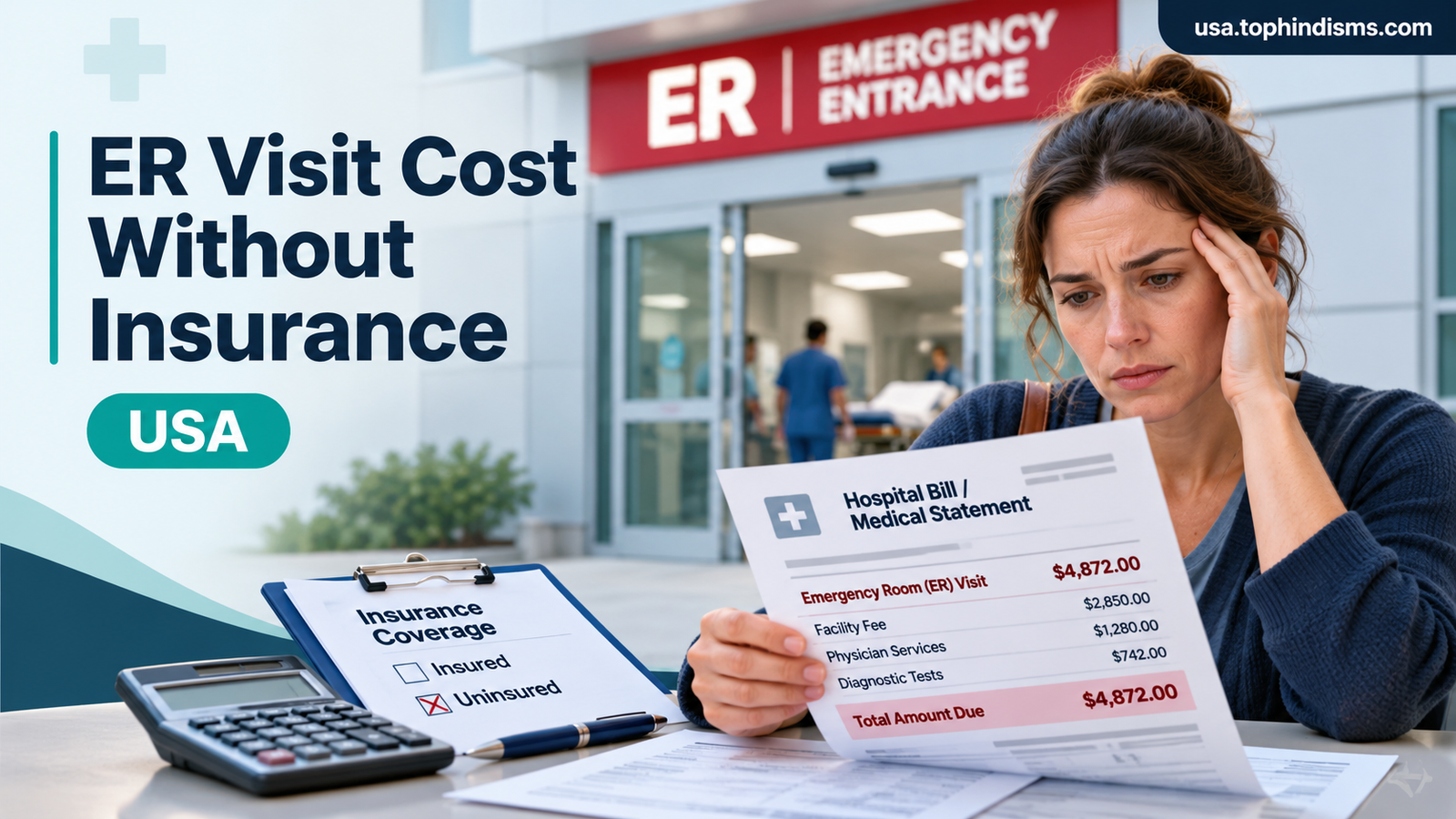
Going to the emergency room is stressful enough. Finding out how much the visit costs when you don’t have health insurance can make the situation even more overwhelming.
Maybe you went to the ER because of severe stomach pain, an unexpected injury, or a sudden illness. You received treatment, went home, and started wondering how much the bill would be.
Here’s what you should know: There is no single fixed price for an emergency room visit without insurance in the United States.
Your bill depends on the hospital, the complexity of your visit, the tests and treatments you receive, and whether you qualify for discounts or financial assistance.
The good news is that you may have options for reviewing and reducing what you owe.
How Much Does an ER Visit Cost Without Insurance?
An emergency room visit can involve several separate charges, making it difficult to predict the total.
One useful piece of research comes from a study published in Health Affairs that examined emergency department pricing at 1,621 U.S. hospitals.
Using hospital pricing information from 2021, researchers found that the median published discounted cash prices for emergency department facility fees varied substantially depending on the complexity of the visit.
| ER Visit Level | Median Published Cash Facility Fee |
|---|---|
| Level 1 | $160.78 |
| Level 2 | $268.50 |
| Level 3 | $453.18 |
| Level 4 | $733.92 |
| Level 5 | $1,097.43 |
Important: These figures come from 2021 hospital pricing data. They represent median facility fees, not complete ER bills or current 2026 prices.
A hospital may charge separately for the emergency physician, laboratory work, imaging, medications, supplies, and other services.
For that reason, your total bill could be substantially higher than the facility fee alone.
The study also found meaningful differences between hospitals, reinforcing why a single national price estimate can be misleading.
What Makes Emergency Room Visits So Expensive?
Emergency departments operate differently from ordinary medical offices.
Hospitals must maintain equipment, facilities, and medical personnel capable of responding to urgent and potentially life-threatening situations.
Even when a patient needs relatively straightforward treatment, an emergency department may involve resources that aren’t typically available at a routine clinic.
Let’s look at the charges that may appear on your bill.
1. Emergency Department Facility Fee
The facility fee generally reflects the hospital resources associated with providing emergency care.
Depending on the hospital’s billing practices, the fee may relate to the resources used during your visit and the complexity of the services provided.
A higher-level emergency department visit generally involves more intensive evaluation or resources.
However, a high facility fee doesn’t automatically mean the patient received a major procedure.
2. Emergency Physician Charges
You may receive a separate bill from the physician or medical group that evaluated you.
This can surprise patients who expected a single bill from the hospital.
The physician’s charge and the hospital’s facility charge are not necessarily the same thing.
3. Diagnostic Tests
Blood tests, urine tests, X-rays, CT scans, and other diagnostic services can increase the total cost.
For example, a patient with severe abdominal pain might need laboratory testing and medical imaging before the emergency team can understand what is happening.
These services may appear as separate charges.
4. Medications and Medical Supplies
Medications, intravenous fluids, wound-care supplies, and other items used during treatment can also contribute to the bill.
5. Additional Treatment or Hospital Admission
If the emergency department determines that you need surgery, specialized treatment, observation, or hospitalization, the financial situation becomes more complicated.
An ER visit that leads to inpatient admission can involve charges beyond the original emergency department evaluation.
Why Two Patients Can Receive Very Different ER Bills
Suppose two people visit the same emergency department because of abdominal pain.
One person receives an examination and is discharged after the medical team determines that additional testing isn’t needed.
The other person needs blood work, imaging, medication, and further observation.
Even though both patients arrived with a similar complaint, the services provided could result in very different bills.
Hospital pricing policies and available discounts can create additional differences.
This is why an article promising that every uninsured patient will pay one specific amount would not be reliable.
Can You Go to the ER Without Insurance?
Yes.
Under the federal Emergency Medical Treatment and Labor Act, commonly known as EMTALA, covered hospital emergency departments must provide an appropriate medical screening examination to determine whether an emergency medical condition exists.
When an emergency medical condition is identified, the hospital generally must provide necessary stabilizing treatment within its capabilities or arrange an appropriate transfer under the law.
These obligations apply regardless of a person’s ability to pay.
However, EMTALA does not mean emergency care is automatically free.
You may still receive bills after the hospital provides care.
If you’re dealing with a potentially serious medical emergency, don’t delay necessary treatment simply because you’re worried about the cost.
For severe symptoms such as chest pain, serious breathing difficulties, signs of a stroke, or uncontrolled bleeding, seek emergency assistance. In the United States, call 911 when appropriate.
Does the No Surprises Act Protect Patients Without Insurance?
The federal No Surprises Act includes important medical billing protections, but they do not all work the same way.
Certain protections against unexpected out-of-network emergency bills apply to people with qualifying health insurance coverage.
For uninsured or self-pay patients, another important part of the law involves Good Faith Estimates for certain scheduled or requested services.
However, providers generally are not required to give a Good Faith Estimate during emergency care.
That distinction matters.
You should not assume that an unexpected emergency room bill automatically qualifies for the federal patient-provider dispute process available for certain bills that exceed a Good Faith Estimate.
Other federal or state protections may still be relevant, depending on your circumstances.
Can You Get an ER Bill Reduced Without Insurance?
Possibly.
The amount printed on the first bill may not always be the final amount you’re required to pay.
Hospitals may offer uninsured discounts, financial assistance, or payment arrangements, depending on their policies.
Here are some practical steps worth considering.
1. Ask About Self-Pay Discounts
Contact the hospital’s billing department and explain that you don’t have health insurance.
Ask whether the hospital offers a discount for uninsured or self-pay patients.
You can ask:
“Do you offer an uninsured patient discount, and can you explain how it would apply to my bill?”
If a discount is available, request the details in writing.
2. Check the Hospital’s Financial Assistance Policy
Many nonprofit hospitals have financial assistance programs, sometimes called charity care.
Under federal tax rules, hospitals subject to Internal Revenue Code Section 501(r) must maintain a written financial assistance policy for eligible emergency and other medically necessary care.
Eligibility requirements vary by hospital.
The policy may consider income, household size, financial circumstances, or other factors.
Not every medical provider billing you separately will necessarily be covered by the hospital’s financial assistance policy.
Ask the billing department for a copy of the policy and an explanation of how to apply.
3. Request an Itemized Bill
A medical bill showing only a total amount doesn’t always provide enough information to understand the charges.
Ask for an itemized statement.
Review the dates of service, listed procedures, medications, facility fees, and other charges.
If you don’t recognize something, ask the billing department to explain it.
An unfamiliar charge isn’t automatically an error, but you should understand what you’re being asked to pay.
4. Ask About Payment Plans
If you cannot afford the entire bill at once, ask whether the hospital offers a payment plan.
Before agreeing, confirm the monthly payment amount, duration, interest, fees, and consequences of missed payments.
Get the terms in writing.
5. Check Possible Coverage Options
Depending on your circumstances and state, you may qualify for Medicaid or another coverage program.
Ask an appropriate state agency or enrollment assistance organization whether any coverage options could apply to your situation, including care you’ve already received.
Eligibility and any retroactive coverage rules depend on the program and individual circumstances.
What If You Receive More Than One Bill?
Receiving multiple bills after one emergency room visit isn’t necessarily a mistake.
For example, you might receive separate statements from:
- The hospital
- An emergency physician group
- A radiology provider
- A laboratory or another medical service provider
Before paying, identify who issued each bill and which services it covers.
You can also ask whether any financial assistance arrangement applies to the separate provider charges.
Keep copies of the statements, correspondence, and payment confirmations.
How to Review an ER Bill Before Paying
When your emergency room bill arrives, consider following this checklist.
| What to Check | Why It Matters |
|---|---|
| Patient and service details | Confirm the bill belongs to you and lists the correct visit |
| Dates of service | Identify possible incorrect or repeated dates |
| Itemized charges | Understand what services were billed |
| Discounts | Check whether uninsured discounts have been applied |
| Financial assistance | Determine whether you qualify for help |
| Separate physician bills | Understand which providers are charging you |
| Payment arrangements | Review available options before agreeing |
If you believe a charge is incorrect, contact the billing department and request clarification.
The Consumer Financial Protection Bureau also recommends reviewing medical bills for errors, obtaining an itemized list when needed, and exploring financial assistance.
ER vs. Urgent Care: Which Is Less Expensive?
Urgent care centers generally cost less than hospital emergency departments for services they are equipped to provide.
However, these facilities serve different medical needs.
An urgent care center may be appropriate for certain non-life-threatening conditions, depending on the center’s capabilities.
Emergency departments are equipped to evaluate and treat potentially serious emergencies.
For example, an uncomplicated minor concern may be suitable for an urgent care clinic. Severe chest pain or symptoms suggesting a stroke require immediate emergency evaluation instead.
Cost should not be the deciding factor when delaying emergency care could put your health at risk.
If you’re unsure whether a condition is an emergency, seek appropriate medical guidance promptly.
Can a Hospital Refuse to Treat You Because You Cannot Pay?
A covered emergency department cannot refuse an appropriate medical screening examination solely because you lack insurance or cannot pay.
If an emergency medical condition is identified, EMTALA generally requires stabilizing treatment or an appropriate transfer consistent with the law.
However, this federal law does not guarantee free care, eliminate future bills, or require every type of nonemergency service to be provided without payment.
Knowing the difference between a right to emergency evaluation and the financial responsibility that may follow is important.
What Should You Say When Calling the Hospital Billing Department?
You don’t need to understand every medical billing term before asking for help.
Here’s a simple way to start the conversation:
“Hello, I recently received an emergency room bill, and I don’t have health insurance. I’d like to understand the charges and find out whether your hospital offers uninsured discounts or financial assistance. Could you also explain how to request an itemized statement?”
Write down the representative’s name, the date of your call, and any instructions you receive.
If you’re submitting financial assistance documents, ask how to confirm that the application has been received.
You can also ask what will happen to the account while your application is being reviewed.
Frequently Asked Questions
Is an emergency room visit free without insurance?
Not necessarily. EMTALA generally requires covered emergency departments to provide an appropriate medical screening examination and necessary stabilizing care regardless of ability to pay. It does not automatically make the care free.
How much does a Level 3 ER visit cost without insurance?
A study using 2021 pricing information from 1,621 U.S. hospitals found a median published discounted cash facility fee of $453.18 for Level 3 emergency department visits.
That amount is historical and covers the facility fee only. Additional charges and current prices can vary substantially.
Can I negotiate an emergency room bill?
You can ask the billing department whether uninsured discounts, financial assistance, billing adjustments, or payment arrangements are available. Approval is not guaranteed.
Do nonprofit hospitals offer financial assistance?
Tax-exempt hospital facilities subject to IRS Section 501(r) must maintain qualifying financial assistance policies. Whether you qualify depends on the hospital’s written policy and your circumstances.
Can I request a Good Faith Estimate for emergency treatment?
The federal Good Faith Estimate requirements generally apply to certain scheduled or requested care when you’re not using insurance. Providers are not required to provide one during emergency care.
What if I cannot afford my ER bill?
Contact the billing department, request an itemized bill, ask about financial assistance or uninsured discounts, and review available payment options. Don’t assume that the first amount listed is necessarily your final responsibility.
Final Thoughts
An emergency room visit without insurance can be expensive, but understanding the bill can make the next steps less intimidating.
There is no trustworthy single price that applies to every uninsured ER patient in the United States.
The total depends on the hospital, the services received, the complexity of care, and any adjustments or assistance available.
If you’re facing an unexpected bill, start by understanding the charges. Ask about self-pay discounts, review the hospital’s financial assistance policy, and request an itemized statement when needed.
The most useful question isn’t only “How much does an ER visit cost?” It’s also “What am I actually responsible for paying, and what options are available?”
Sources and Further Reading
The following resources provide additional information about emergency department charges, patient rights, and financial assistance.
- Health Affairs — Hospital and Regional Characteristics Associated With Emergency Department Facility Fee Cash Pricing
- CMS — Emergency Medical Treatment & Labor Act (EMTALA)
- CMS — Medical Bill Rights When Not Using Insurance
- CMS — Hospital Price Transparency for Consumers
- IRS — Financial Assistance and Emergency Medical Care Policies
- Consumer Financial Protection Bureau — What Should I Do if I Can’t Pay a Medical Bill?
- FAIR Health Consumer — Emergency Care and Urgent Care
Disclaimer: This article provides general educational information about healthcare costs and billing in the United States. It does not replace individualized medical, legal, insurance, or financial advice. In a medical emergency, seek immediate care.